
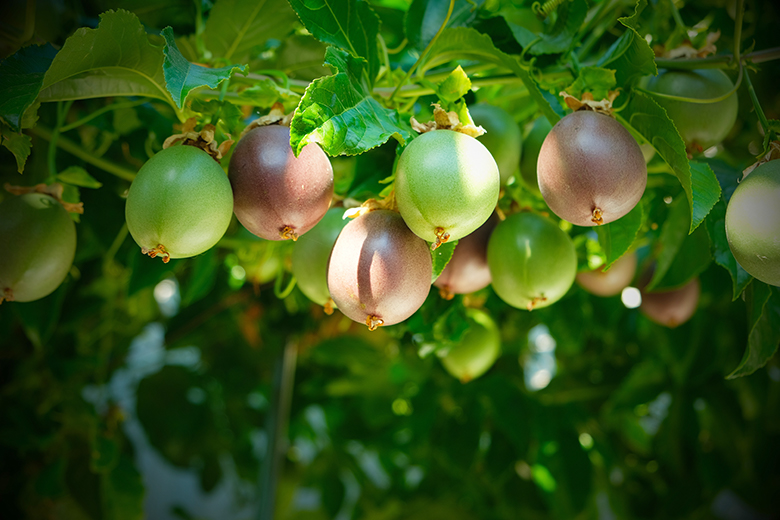
Passion fruit cultivation is a highly profitable venture for farmers who prioritize proper management. These tropical fruits, known for their sweet-tart flavor, are versatile enough for juices, desserts, and fresh export. However, achieving high yields requires a deep understanding of growth stages and pest control.
Description
Passion fruit belongs to the Passiflora genus, and its fruit is highly aromatic, with a pulp full of edible seeds. It grows on a vine that requires support, as the plant is a climbing shrub. The fruit is rich in vitamin C, fiber, and antioxidants, making it a nutritious addition to any diet. The flavour is a combination of sweet and tangy, with a strong citrus note.
Ideal Conditions for Passion Fruit Growth
Before planting, you must ensure your environment meets these specific requirements:
- Support: Because the plant is a climbing shrub, it requires strong fences or pergolas.
- Soil: Deep, fertile, well-drained soil with a pH of 6.0–7.5.
- Climate: Temperatures between 20–30°C and annual rainfall of 900–2000 mm.
The 5 Critical Stages of Passion Fruit Farming
Successful passion fruit cultivation happens in distinct phases. Consequently, missing a step in one stage can ruin your harvest in the next.
- Harvesting (12–16 Weeks): Pick only when the fruit reaches full color.
- Nursery & Transplanting (0–2 Weeks): Focus on root development and stress management.
- Vegetative Stage (3–4 Weeks): This is when the plant builds stems and leaves.
- Flowering Stage (5–7 Weeks): Critical for fruit set. Avoid flower abortion here.
- Fruiting Stage (8–11 Weeks): Proper nutrition ensures large, heavy fruits.
Managing Passion Fruit Diseases
Diseases can wipe out a vineyard quickly. Therefore, early identification is essential.
- Fusarium Wilt & Root Rot: This is the most dangerous soil-borne threat. Specifically, you should drench with Topguard 500SC to save the roots.
- Leaf Spots: Use Orizole 250EC or Topguard 500SC to stop fungal spread.
- Downy Mildew: Apply Tajiri 720WP as a preventative measure during the nursery stage.
- Powdery Mildew & Anthracnose: Use Tabibu 500SC, Dewklin 250EC, or Orizole 250EC.
Effective Pest Control Strategies
Pests not only damage the fruit but also spread viruses. Furthermore, some pests live in the soil and attack from below.
- Nematodes: Protect roots by applying Foscap 105GR in planting holes or drenching with Foscap Top 250ME.
- Mealy Bugs & Aphids: Use Acetak Top 700WG or Vendex 50EC for fast control.
- Thrips & Leaf Miners: Rotate Agrimec 18EC, Cadence Gold, or Emmaron 30SC.
- Fruit Flies: These are common during ripening. Use May 50EC to prevent “stinging” of the fruit.
Advanced Nutrition and Weed Management
- Proper nutrition is the secret to “Grade A” passion fruits. In addition to soil fertilizers, foliar sprays provide an instant boost.
- For Fruit Quality: Use Cabozinc SC (56% Liquid Calcium) to prevent flower abortion and produce heavy, juicy fruits.
- For Stress: Use Genie Gold 500SL (Seaweed extract) to help young plants recover from transplanting.
- For Growth: Apply Brilliant (Ammonium Phosphate) and Microfert TI during the vegetative stage.
Weed Control
Before planting, clear the land using Kausha 480SL (Glyphosate). During growth, keep grasses short for soil conservation.
Pro Tip: Always mix Golden Leaf(Wetter/Sticker) with every spray to ensure the chemicals stick to the waxy passion fruit leaves.
Fletcher
Attractive component to content. I just stumbled upon your site and in accession capital to say that I get actually enjoyed
account your blog posts. Anyway I will be subscribing on your augment
and even I success you get right of entry to consistently rapidly.
Ustadh Nuno
A very good website with important information. I wish you could have indicated the cost of each chemical inputs or foliar feed listed herein. Thank you
Ustadh Nuno
Very useful information. I wish you could have summarized the information in table format. Thank you