Potatoes are a high-value crop. When healthy, they produce good-sized tubers and good profits. But one disease can quickly destroy a potato field — blight.
Many farmers have seen potato leaves turn brown, dry quickly, and the crop collapse before maturity. In most cases, the problem is Early or Late Blight.
Let us understand what blight is, how it affects potatoes, and how to control it effectively.
What Is Blight?
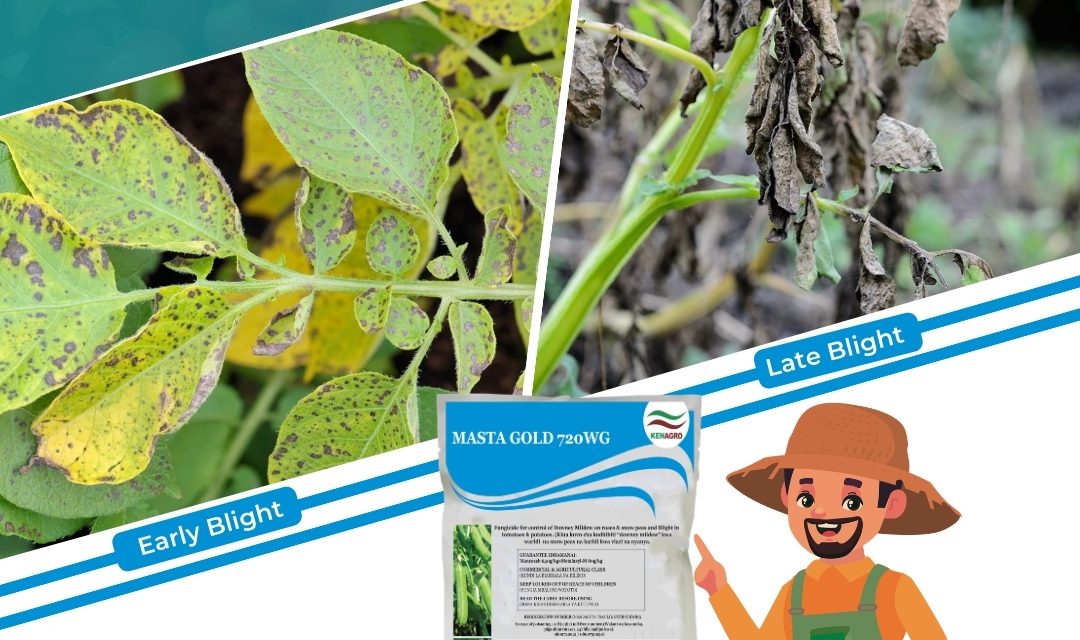
Blight is a fungal disease that attacks potatoes. There are two main types:
- Early Blight (caused by Alternaria solani)
- Late Blight (caused by Phytophthora infestans)
Both diseases affect leaves, stems, and sometimes tubers.
Late Blight spreads very fast, especially during cool and wet weather. Early Blight is more common in warm conditions and stressed crops.
Stages of Blight in Potatoes
Blight develops in stages. Acting early makes control easier and cheaper.
Stage 1: First Leaf Spots
- Small brown spots appear on lower leaves.
- Early Blight spots may look like rings (target-like pattern).
- Late Blight spots look water-soaked and spread quickly.
This is the best time to spray.
Stage 2: Rapid Spread
- Spots enlarge and join together.
- Leaves turn yellow and then brown.
- Stems may develop dark patches.
The plant loses its ability to make food properly.
Stage 3: Severe Infection
- Leaves dry completely.
- Plants collapse.
- Tubers may become infected (especially with Late Blight).
At this stage, yield loss is very high.
How Much Damage Can Blight Cause?
If not controlled:
- Yield losses can reach 50%–100%.
- Tubers become small.
- Storage quality reduces.
- Entire fields may dry before harvest.
Late Blight can destroy a potato crop within days under rainy conditions.
Prevention and early spraying are very important.
Agronomic Practices to Prevent and Manage Blight
Good farming practices reduce disease pressure and improve fungicide performance.
1. Use Certified, Disease-Free Seed Tubers
- Avoid planting infected seed.
- Inspect seed before planting.
- Do not plant tubers showing rot or lesions.
Healthy seed is the foundation of a healthy crop.
2. Practice Crop Rotation
- Avoid planting potatoes in the same field season after season.
- Rotate with cereals or legumes.
Crop rotation reduces disease build-up in the soil.
3. Proper Spacing
- Avoid overcrowding.
- Allow good air circulation.
Good airflow reduces humidity and slows disease spread.
4. Improve Drainage
- Avoid waterlogging.
- Plant on ridges.
- Ensure proper drainage channels.
Wet conditions favor blight.
5. Remove Infected Plants Early
- Uproot severely infected plants.
- Destroy them away from the field.
This reduces spread.
6. Start Preventive Spraying Early
Do not wait for heavy infection. Spray before or at the first signs of disease, especially during rainy seasons.
Best Active Ingredients for Blight Control
For effective control of Early and Late Blight in potatoes, two powerful active ingredients are highly recommended:
Mancozeb – Protective Fungicide
Mancozeb works by:
- Forming a protective barrier on leaves.
- Preventing fungal spores from germinating.
- Stopping new infections before they start.
It protects the crop from outside infection.
Metalaxyl-M – Systemic Fungicide
Metalaxyl-M works by:
- Penetrating into plant tissues.
- Controlling fungal infection from inside the plant.
- Stopping disease development at early stages.
It is especially effective against Late Blight.
Why Combination Products Work Better
When Mancozeb and Metalaxyl-M are combined:
- The plant is protected on the outside.
- Existing infection is controlled from inside.
- Both Early and Late Blight are managed effectively.
- Resistance risk is reduced.
This provides stronger and more reliable protection.
Recommended Solution: Masta Gold 720WG
For effective control of Early and Late Blight in potatoes, we recommend:
Masta Gold 720WG
It contains:
- Mancozeb 640g/Kg
- Metalaxyl-M 80g/Kg
Benefits of Masta Gold 720WG
✔ Strong preventive and curative action
✔ Effective against Early and Late Blight
✔ Protects leaves and stems
✔ Supports healthy tuber development
✔ Improves yield and quality
When and How to Spray
- Start spraying early, especially during wet and cool conditions.
- Spray at the first sign of disease.
- Ensure full coverage of leaves and stems.
- Follow recommended dosage and spray intervals.
Early spraying gives better and cheaper control.
Final Advice to Farmers
Blight is one of the most dangerous diseases in potato farming. But it can be controlled with:
- Good agronomic practices
- Early detection
- Timely fungicide application
- A reliable product like Masta Gold 720WG
Healthy leaves mean healthy tubers.
Healthy tubers mean better market prices.
Better prices mean better profits.
Protect your potatoes early. Protect your investment. Secure your harvest.