
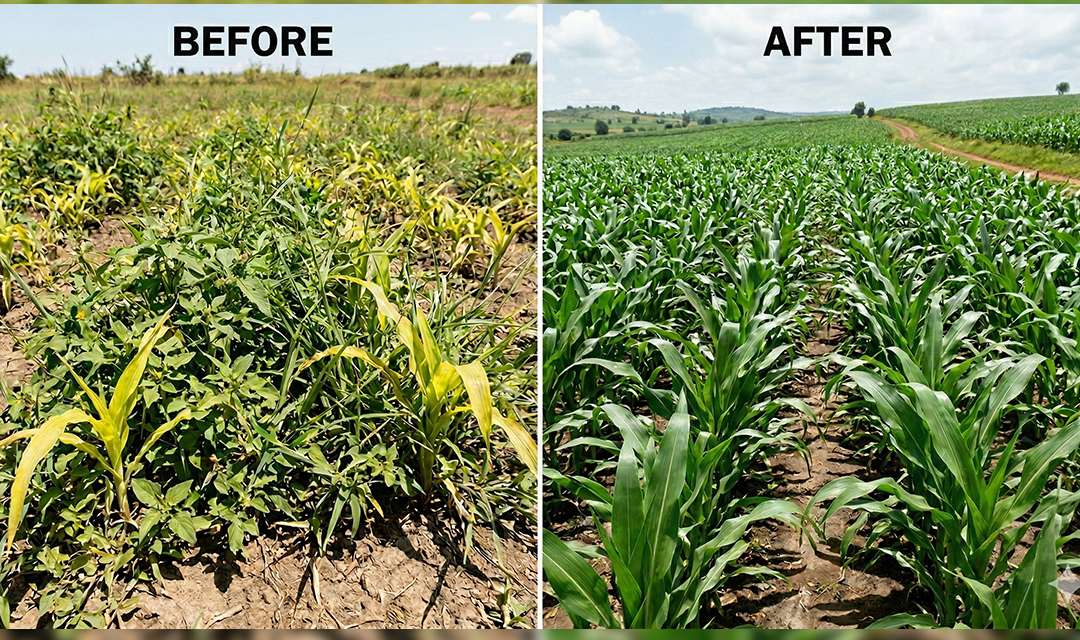
Maize weed control is one of the most critical factors in successful farming. Weeds are a major enemy, competing with your crop for nutrients, water, sunlight, and space. If you do not prioritize maize weed control early, yields can be reduced by more than 50%.
Understanding how weeds grow and how to manage them will help farmers harvest more and earn better profits.
Why Weed Control is Important
The first 4–6 weeks after planting are the most critical “weed-free” period. Effective maize weed control during this window ensures:
- Nutrient Retention: Weeds don’t steal your expensive fertilizer.
- Water Conservation: Maize gets the moisture it needs during dry spells.
- Pest Reduction: Many weeds harbor pests that eventually attack your maize.
The first 4–6 weeks after planting maize are the most critical. If weeds are controlled during this period, maize can grow strong and healthy.
Common Types of Weeds in Maize Fields
To achieve total maize weed control, you must identify your enemies:
1. Broad-Leaved Weeds
- Have wide leaves
- Spread quickly
- Example: blackjack, pigweed, wandering jew
2. Grasses
- Look like maize in early stages
- Have narrow leaves
- Example: couch grass, foxtail, wild grasses
Both types must be controlled for good yields.
Agronomic Practices to Reduce Weed Problems
Good farming practices reduce weed pressure even before spraying.
✔ Land Preparation
Proper ploughing buries weed seeds and destroys existing weeds.
✔ Early Planting
Plant at the onset of rains so maize grows faster and suppresses weeds.
✔ Correct Spacing
Proper spacing allows maize to cover the ground quickly and shade weeds.
✔ Crop Rotation
Avoid planting maize in the same field season after season.
✔ Use Clean Seed
Avoid introducing new weeds into your farm.
✔ Timely Weeding
Control weeds before they flower and produce seeds.
Best Active Ingredients for Weed Control in Maize
To effectively control both grasses and broad-leaved weeds, the following active ingredients are highly recommended:
1. S-Metolachlor
- Controls annual grasses
- Controls some small broad-leaved weeds
- Works mainly as a pre-emergence herbicide (applied before weeds emerge)
2. Terbuthylazine
- Controls many broad-leaved weeds
- Provides residual (long-lasting) control
- Works well in combination with other herbicides
3. Mesotrione
- Controls tough broad-leaved weeds
- Effective both pre- and early post-emergence
- Causes whitening of weeds before they die
Why Combine These Three?
When S-Metolachlor, Terbuthylazine, and Mesotrione are combined:
✔ They control both grasses and broad-leaved weeds
✔ Provide longer protection
✔ Reduce need for repeated weeding
✔ Help improve maize yield
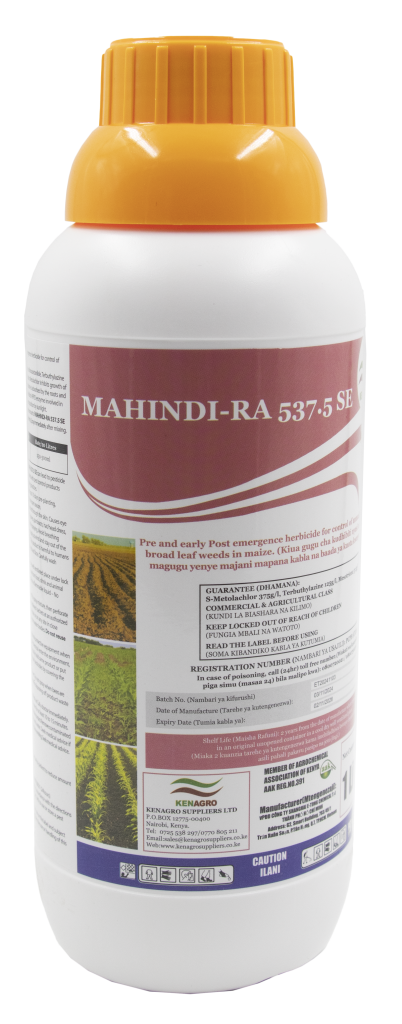
Recommended Product: Mahindi-Ra 537.5SE
For reliable, season-long maize weed control, farmers are encouraged to use Mahindi-Ra 537.5 SE at a rate of 250-400ml/20L of water..
Product Composition:
- S-Metolachlor 375g/L
- Terbuthylazine 125g/L
- Mesotrione 37.5g/L
Benefits of Mahindi-Ra 537.5SE:
✔ Broad-spectrum weed control
✔ Controls grasses and broad-leaved weeds
✔ Long residual protection
✔ Reduces labor costs
✔ Promotes vigorous maize growth
When and How to Apply
For best results:
- Apply immediately after planting (pre-emergence) or early post-emergence as recommended.
- Ensure soil has enough moisture.
- Use correct dosage as per label instructions.
- Avoid spraying when wind is strong.
Always follow safety instructions when handling herbicides.
Do not allow weeds to compete with maize in the first 4–6 weeks. Combine good agronomic practices with effective herbicides. Early weed control leads to higher yields and better profits. Use trusted products like Mahindi-Ra 537.5 SE for reliable and season-long weed control. Good weed control means strong maize and a better harvest.




Cydney kagera
A good informative description
Jacob Yego
Will spray using Mahindi-RA is 5 ltrs enough for 5 acres maize plantation advice