
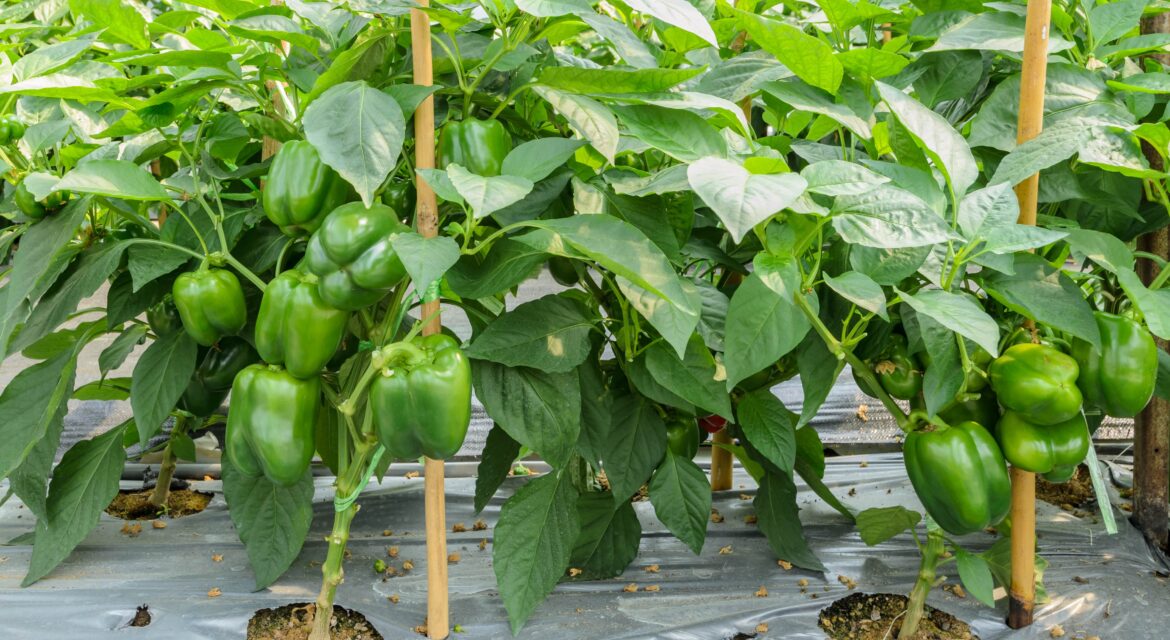
Capsicum farming, commonly known as sweet pepper or hoho in Kenya, is one of the most profitable horticulture enterprises today. Driven by booming urban demand, high-end hotel orders, and export opportunities, fresh capsicum yields fast returns for both open-field and greenhouse farmers.
Whether you plan to grow green, yellow, or red capsicums, adopting proper agronomic practices is essential for harvesting high-quality, market-grade peppers.
1. Selecting the Best Capsicum Varieties in Kenya
Selecting the right seed variety determines your yield potential, fruit size, shelf life, and resistance to common field diseases.
Popular Open-Field & Hybrid Varieties:
- Indra F1: Highly popular hybrid known for heavy yields, thick flesh, excellent shelf life, and strong resistance to bacterial wilt.
- California Wonder: An open-pollinated blocky green variety with wide adaptability across warm regions in Kenya.
- Yolo Wonder: Excellent for open-field farming, yielding sweet, thick-walled green peppers that turn red when mature.
- Commander F1 & Pilot F1: Outstanding colored varieties (Red and Yellow) widely grown under controlled greenhouse environments.
2. Soil, Climate, and Ecological Requirements
Capsicums require warm climatic conditions and nutrient-rich soil to thrive.
- Ideal Temperature: 20°C to 30°C. Temperatures below 15°C stunt growth, while extreme heat above 35°C leads to blossom drop.
- Soil Type: Deep, well-drained loamy or sandy-loam soils rich in organic matter.
- Soil pH: Optimal range is 5.5 to 6.8.
- Altitude: Thrives at altitudes between 0 and 2,000 meters above sea level.
3. Land Preparation, Seedling Production & Spacing
Nursery Management:
- Sow seeds in nursery beds or propagation trays using cocopeat/vermiculite.
- Water gently and maintain consistent moisture.
- Seedlings are ready for transplanting 4 to 6 weeks after sowing (when they reach 12–15 cm in height and have 4–6 true leaves).
Spacing & Field Setup:
- Plant Spacing: Maintain 60 cm between rows and 45 cm between plants ($60 \text{ cm} \times 45 \text{ cm}$). This gives a plant population of roughly 14,000 to 15,000 plants per acre.
- Mix well-rotted manure and DAP (or TSP) fertilizer into each planting hole during transplanting to encourage strong root development.
4. Water Management, Fertilization & Trellising
Irrigation:
Capsicums have a moderately shallow root system and require consistent moisture. Drip irrigation is highly recommended as overhead watering increases fungal leaf diseases.
Fertilization Schedule:
- Transplanting: Organic manure + DAP fertilizer.
- 3 Weeks After Transplanting: Top-dress with CAN (Calcium Ammonium Nitrate) or Nitrogen-rich fertilizers to promote vegetative growth.
- Flowering & Fruiting Stage: Apply NPK (17:17:17 or 15:15:15) along with Calcium-based foliar feeds to prevent Blossom End Rot.
Pinching & Staking:
- Staking/Trellising: Support heavy-fruiting plants with wooden stakes or string lines to prevent branches from snapping under the weight of large peppers.
- Pinching: Remove the first blossom cluster (crown flower) to encourage the plant to direct energy toward structural branch growth first.
5. Major Capsicum Pests and Diseases (And How to Control Them)
| Pest / Disease | Symptoms | Control / Management |
| Thrips | Crinkled leaves, silvering on leaf undersides | Spray registered systemic insecticides; use yellow sticky traps. |
| Whiteflies & Aphids | Leaf curling, honeydew excretion, yellowing | Apply neem oil or systemic insecticides; control field weeds. |
| Bacterial Wilt | Sudden wilting of the plant while leaves remain green | Use resistant hybrids like Indra F1; practice crop rotation. |
| Blossom End Rot | Black, sunken spots at the bottom of the fruit | Maintain steady drip irrigation; apply Calcium foliar sprays. |
| Powdery Mildew | White powdery spots on leaf undersides | Ensure adequate spacing for airflow; apply copper-based fungicides. |
6. Harvesting, Yields, and Marketing Strategies
Harvesting Timeline:
Capsicums are ready for harvest 75 to 90 days post-transplanting. Harvesting can continue for 3 to 6 months under proper care.
- Yield Potential: Open-field crops yield 10 to 15 tonnes per acre, while high-tech greenhouses can yield over 25 to 30 tonnes per acre.
Marketing Channels in Kenya:
- Direct sales to major urban wholesale markets (Wakulima Market, Kongowea, Muthurwa).
- Direct supply contracts with supermarkets, hotels, and restaurant chains.
- Export buyers for premium uniform green and colored peppers.
Julie
Insightful post! As an international fresh produce exporter, I really appreciate your thoughts.|
Thank you for posting this. It’s great to read content that talks about global trade.|
We’ve been working hard on improving traceability
as a fruit and vegetable exporter.|
Looking forward to more posts like this.|
Cheers from Turkey.
Angelika
I read this paragraph completely about the difference of most recent and previous technologies, it’s remarkable article.
Alhassan Abdulmananu
I have seen your product and am very happy to see it, and it is nice and i want as to Link each other in Ghana to help the farmers in Ghana please