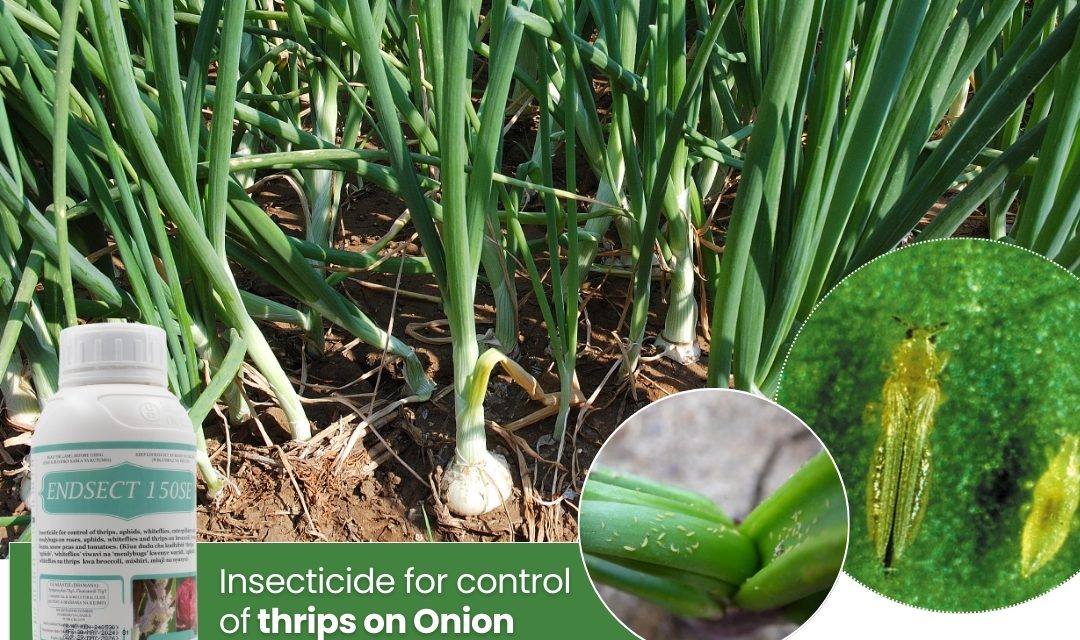
Thrips are one of the most serious pests in onion farming. They are very small, but the damage they cause is very big.
Many farmers only notice the problem when leaves turn silvery, dry at the tips, and bulbs stop growing well. By that time, yield has already reduced.
Let us understand what thrips are, how they damage onions, and the best way to control them.
What Are Thrips?
Thrips are tiny, slender insects that suck sap from onion leaves.
The most common species attacking onions is the Onion Thrips (Thrips tabaci).
They are very small and usually hide inside the folds of onion leaves, making them difficult to see and spray.
Thrips multiply very fast, especially in:
- Hot weather
- Dry conditions
- Fields with poor spray coverage
Stages of Thrips
Thrips go through several stages:
- Eggs
- Larvae (young thrips)
- Pupa
- Adult
The larvae and adults are the stages that feed on onion leaves.
In warm weather, thrips can complete their life cycle in about 2–3 weeks. This means their population can increase very quickly.
How Thrips Damage Onions
Thrips damage onions by sucking plant sap from leaves.
Early Damage
- Leaves develop white or silvery patches.
- Leaves look scratched or shiny.
This is the best time to control them.
Moderate Damage
- Leaf tips turn yellow.
- Leaves begin to curl.
- Plant growth slows down.
Photosynthesis reduces, and bulb formation is affected.
Severe Damage
- Leaves dry from the tips downward.
- Bulbs remain small.
- Maturity is affected.
Heavy infestation can reduce yields by 30% to 60% or more.
What Happens If Thrips Are Not Controlled?
If left uncontrolled:
- Bulb size reduces significantly.
- Quality drops.
- Plants become weak and stressed.
- Secondary diseases may increase.
In dry and hot seasons, thrips can destroy a large part of the crop if action is delayed.
Early monitoring and timely spraying are very important.
Agronomic Practices to Reduce Thrips
Good farming practices help reduce thrips pressure.
1. Field Hygiene
- Remove weeds around the field.
- Weeds can host thrips.
- Destroy crop residues after harvest.
2. Proper Irrigation
Thrips prefer dry conditions.
- Avoid water stress.
- Maintain proper soil moisture.
- Healthy plants tolerate pests better.
3. Regular Scouting
- Check inside onion leaves weekly.
- Look for silvery patches and tiny insects.
- Act early before populations explode.
Even with good practices, insecticides are necessary for effective control during heavy infestations.
Best Solution for Thrips Control
For effective control of thrips in onions, we recommend:
Endsect 150SE
From Kenagro Suppliers Limited
It contains:
- Pyriproxyfen 75g/L
- Flonicamid 75g/L
Used together with:
Cadence Gold
(A powerful thrips adjuvant)
How These Active Ingredients Work
Pyriproxyfen
Pyriproxyfen is an insect growth regulator.
What it does:
- Prevents immature thrips from developing into adults.
- Disrupts the life cycle.
- Reduces future populations.
It helps stop the next generation of thrips.
Flonicamid
Flonicamid is a fast-acting feeding blocker.
What it does:
- Stops thrips from feeding quickly.
- Reduces plant damage.
- Controls both larvae and adults.
When thrips stop feeding, leaf damage reduces immediately.
Why Combine Endsect 150SE with Cadence Gold?
Thrips hide deep inside onion leaves.
Cadence Gold (adjuvant):
- Improves spray spreading.
- Helps the insecticide penetrate leaf folds.
- Increases contact with hidden thrips.
- Improves overall effectiveness of the spray.
Better coverage means better control.
Benefits of Using Endsect 150SE + Cadence Gold
✔ Controls larvae and adult thrips
✔ Breaks the thrips life cycle
✔ Reduces feeding damage quickly
✔ Improves spray coverage
✔ Supports bigger bulb formation
✔ Protects yield and quality
When to Spray
- Spray at the first sign of thrips.
- Do not wait for severe leaf drying.
- Ensure good coverage, especially inside leaf folds.
- Follow recommended dosage and spray intervals.
Early spraying gives better and cheaper control.
Final Advice to Farmers
Thrips may be small, but they can greatly reduce onion yield.
To protect your crop:
- Scout regularly.
- Maintain good field hygiene.
- Avoid plant stress.
- Use the right product at the right time.
Using Endsect 150SE combined with Cadence Gold from Kenagro Suppliers Limited gives strong and reliable control of thrips.
Healthy leaves build bigger bulbs.
Bigger bulbs bring better prices.
Better prices mean better profits.
Control thrips early. Protect your onions. Secure your harvest.